She’s not a daughter you worry about in an obvious way: she’s not failing out of school, she’s not hanging out with a bad crowd, and she’s not in crisis. But something has changed between you, and you can feel it — in the one-word answers, in the door that closes a little too quickly, in the conversations that used to happen easily and now don’t happen at all.
So you start looking for help. You search for a psychologist, a counsellor, a life coach — someone who can work with her. Someone who can get through to her in the way you used to, before whatever changed between you started to change.
That instinct makes complete sense. When your daughter is struggling, the natural response is to find someone else who can reach her.
But there’s a question your search raises that few are answering — and it can result in a key change in where you look for help.
I talk through the same question in a video, including what the research says about working through the parent:
Why so much of the help you find starts with your daughter
If you’ve spent any time searching for a coach or psychologist for your daughter, you’ve probably noticed a pattern in the results. Most of the options put the intervention primarily around your daughter.
The options are all variations on the same idea: individual therapy, teen coaching, social skills groups, or online programs. Each one is designed to work with your daughter directly — to teach her coping skills, build her confidence, help her regulate her emotions, and improve her communication.
Many of these are excellent (and if your daughter has a clinical condition — a diagnosed anxiety disorder, depression, or an eating disorder — she may need professional therapeutic support, and that support is critical).
Your daughter spends time learning new skills; she practises new responses; and she likely comes out of sessions feeling better prepared and ready to apply what she’s learned. But then she comes home — to the same kitchen table, the same conversations, and the same dynamic that was operating before she started her sessions.
So the pattern reasserts itself: not because the sessions didn’t work, but because the environment she returns to hasn’t changed.
Should my teen daughter see a life coach?
Sometimes, yes. A coach can help a daughter work toward something specific — becoming more organized, preparing for a transition, building confidence in one area — when she wants that help herself. If she’s dealing with anxiety, depression, an eating disorder, or anything that affects her safety, she needs support from a psychologist, counsellor, or doctor.
If what brought you here is a pattern between the two of you — the same argument every week, a daughter who has gone quiet, conversations that end with a closed door — coaching for her alone often won’t reach it. She’d be working on her side of a cycle you’re both part of, and the cycle is still there when she comes home.
That’s where you have more leverage than you might expect.
Why the same argument keeps happening (even when both of you are trying)
There’s a reason the same argument keeps happening, the same silence keeps settling in, the same tension keeps building at the same moments. But it isn’t because you’re doing something wrong or your daughter is deliberately being difficult: it’s because interaction patterns between parents and children are self-reinforcing.
The research on this goes back for decades. Gerald Patterson’s work on family interaction dynamics — first published in 1982 and built upon through hundreds of subsequent studies — established something that sounds simple but can change how you think about what’s happening at home: parent-child interaction patterns are two-way.
What that means in practice: your daughter’s behaviour shapes your response, and your response shapes hers. Over time, these sequences become stable. Both people become constrained by the pattern and it narrows what feels available to each of you inside the conversation. Granic and Patterson (2006) described this as rigidity: the interaction system locks into a predictable cycle, and the range of responses available to both of you narrows.
You’ve probably felt this. The conversation starts, and within thirty seconds you can already feel where it’s going. You know what she’s going to say and she knows what you’re going to say. And both of you are right — because the pattern is running the conversation, not either of you. I’ve described the five patterns I see most often in the mothers I work with — and what each one looks like when it runs here.
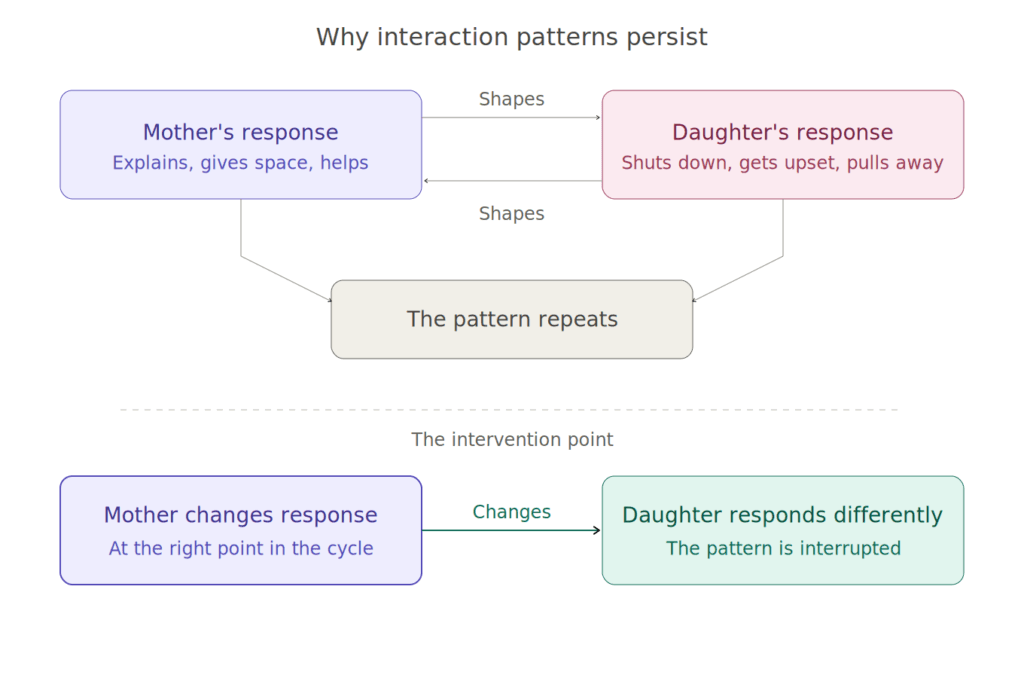
This is why a coach or therapist working only with your daughter faces an inherent limitation: your daughter can learn new responses in the session room, but when she comes home, the pattern cues her back into the old sequence — because the other half of the dynamic hasn’t changed.
What the research says about working through the parent
If patterns are bidirectional — maintained by both people’s behaviour — then it follows that changing one person’s behaviour at the right point in the cycle should alter the entire sequence.
That prediction has been tested in several ways.
A 2024 meta-analysis from Vanderbilt University, published in Clinical Child and Family Psychology Review, examined twenty randomized controlled trials involving over 1,200 adolescents (Pine et al., 2024). Each trial compared the same intervention delivered in two ways: one version worked with the adolescent alone, and the other included a parental component. Overall, adding a parental component produced a small but statistically significant improvement in adolescent outcomes compared with treating the adolescent alone. The advantage was clearest for externalizing problems; it was not statistically significant for internalizing problems such as anxiety and depression.
Alan Carr’s 25-year evidence review, published in the Journal of Family Therapy in 2025, synthesized decades of meta-analyses and systematic reviews across multiple conditions — behavioural problems, substance use, anxiety, mood disorders, eating disorders. Across a wide range of those conditions, systemic interventions that involve the family show strong evidence — and for some problems can outperform working with the young person alone.
And a meta-analysis of 241 studies of parent-training programs for antisocial behaviour found that changes in parent and family outcomes were significantly associated with changes in children’s behavioural outcomes (Beelmann et al., 2023) — supporting the principle that changing what happens in the family interaction can be part of the mechanism of change.
Across these studies, involving parents can improve outcomes, and changes in parent and family behaviour can be part of how change happens.
Where coaching fits when the issue is the interaction pattern
As I noted above, if your daughter has a clinical condition — a diagnosed anxiety disorder, a depressive disorder, or an eating disorder, for example — then she needs professional therapeutic support. A psychologist or psychiatrist working with your daughter may involve you when clinically appropriate. That’s their expertise, and it’s not what this article is about.
What this article is about is the everyday dynamic: the recurring argument that neither of you can seem to stop having; the silence that settled in gradually and now feels permanent; or the tension that builds every time you try to help and she pulls away. Those experiences, by themselves, don’t point to a clinical disorder. Sometimes they’re part of one. Sometimes what you’re dealing with is an interaction pattern — and that’s the kind of work I’m talking about here.
When your daughter refuses to see anyone
There’s a particular version of this worth naming directly, because so many mothers are living it: the daughter who needs support but refuses to go. You’ve suggested a counsellor, and she won’t consider it. You’ve raised the idea of talking to someone, and it ends the conversation. So you’re left feeling that until she agrees, nothing can change.
That isn’t true. The dynamic between you is something you can work on whether or not your daughter ever sits across from a professional. You don’t need her permission to change your part of the pattern, and you don’t need her in the room. This is often where mothers feel most stuck — waiting for a daughter who isn’t ready — when the one part of the pattern that’s fully within reach is their own.
In over 25 years of working with families — across education, learning support, and coaching — I’ve observed five specific interaction patterns that maintain conflict, distance, or friction in the mother-daughter relationship. That observation is informed by training in educational psychology and special education, professional certification in conflict resolution, and ongoing membership in the Association for Contextual Behavioral Science (ACBS). I call them The Five Patterns™, and each one has a recognizable structure: a trigger, a function (what it’s doing for each person, even when it’s painful), and a cost.
These aren’t personality types and they’re not diagnoses: they are patterns — observable sequences between two people that self-reinforce over time unless they’re identified and deliberately interrupted at the right point.
What these patterns look like — and what coaching does with them
The Logic Trap, for example, describes what happens when a mother’s greatest professional strength — her ability to reason clearly and explain things thoroughly — becomes the thing her daughter can’t respond to. The more carefully the mother explains, the more pressure the daughter feels, because the quality of the reasoning leaves no room to simply disagree. The daughter’s only available moves are to argue back or disengage. The mother tries harder to be logical. The daughter pulls further away.
The Drift Dynamic describes the opposite: the silence that builds when a mother gives her daughter space, reading it as respect for her autonomy, while the daughter reads it as not caring enough to step in. The distance increases without arguments, without a clear breaking point — until reconnecting feels much harder than either person expected.
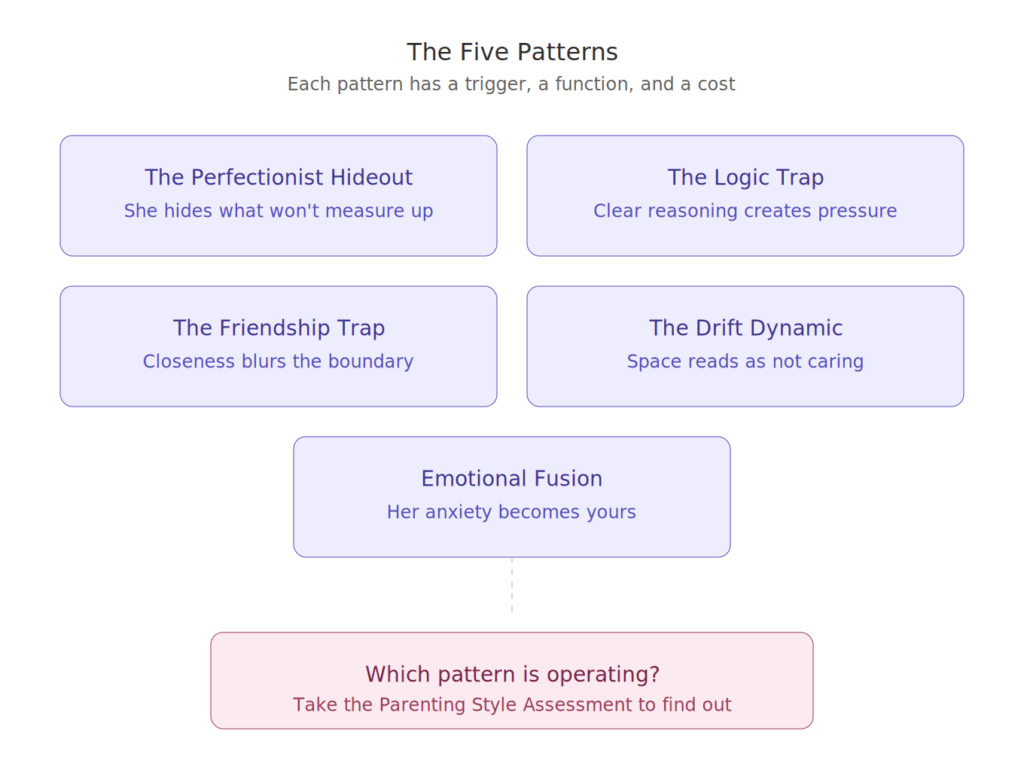
Each pattern has this quality: both people are acting from reasonable intentions, and the pattern between them produces an outcome neither of them wants.
Coaching — specifically, coaching that works with the mother on the interaction dynamic — does something targeted: it identifies which pattern is operating and the specific behavioural sequence that maintains it, and develops the mother’s capacity to respond differently at the precise point in the cycle where the pattern either escalates or changes.
It’s a structured approach consistent with a broader principle in the research: when interaction is bidirectional, changing one person’s response changes what happens next in the sequence.
You can read about each of the Five Patterns and the parenting styles they connect to in this article.
Why it starts with you — and why that isn’t blame
If you’ve read this far, you may be sitting with a complicated feeling, because the idea that you — not your daughter — might be the more effective starting point can come across as an accusation if it isn’t said carefully.
So let me say it carefully.
You are not the cause of this problem (and neither is your daughter). Interaction patterns between you and your daughter developed over time. Your daughter’s temperament, her developmental stage, her social world, her biology — all of these are part of what shapes the dynamic. You did not build this pattern alone, and the fact that it exists does not mean you failed as a mother.
You have something she is still developing: a greater capacity to notice a sequence while it’s happening and deliberately choose a different response — even when every instinct is pulling you toward the familiar move. Your daughter is developing that capacity too, but you generally have more access to it right now, and that’s what makes you the person who can move first.
Because influence runs in both directions, changing your response changes what happens next in the sequence. You don’t need your daughter to change first. You don’t need her to agree that a pattern exists. You need to identify the point in the cycle where your response is part of what maintains it — and choose a different response at that specific point.
I’ve seen this happen concretely. A mother came to me because her daughter had stopped talking to her — really talking — beyond logistics and one-word answers. She’d tried everything: giving her space, initiating conversations, suggesting they do things together, trying to accept it was normal. Nothing was working. When we looked at the pattern, what emerged was that every time her daughter did offer something — a small comment about her day, a half-formed thought about a friend — the mother’s response was to ask a follow-up question. This was both a reasonable and caring response. But for the daughter, each question felt like the opening of an interrogation she hadn’t expected, and she’d go quiet again. And the mother was too far inside the pattern to see her own part in it — which is almost always the case.
The adjustment was small and specific: when the daughter offered something, the mother acknowledged it without asking anything. She just received it — with no follow-up question or attempt to extend the conversation.
Within three weeks, the daughter was talking more. Not because she’d been coached, but because the pattern had been interrupted at the point that was within the mother’s control — her own response.
Where to Start
If the research makes sense to you — if you’re reading this and recognizing something about your own dynamic — there are two concrete next steps.
The first is the Parenting Style Assessment™. It’s free, it takes a few minutes, and it’s designed to help you begin identifying which of the Five Patterns may be operating in your relationship with your daughter. You’re not committing to anything. You’re getting a clearer picture of where you are — which is the necessary first step before anything can change.
The second, for mothers who want a structured assessment of their specific dynamic, is the Mother-Daughter Dynamic Audit. This isn’t an open-ended coaching session. It’s a strategic assessment: I identify which pattern is operating, what’s maintaining it, and what specific adjustment has the highest probability of interrupting the cycle. You leave with a clear picture of what’s happening and a recommendation for where to start.
The question you typed into the search bar was probably some version of “does my daughter need a life coach?” The answer the research points to is more specific than yes or no. Your daughter may benefit from support — but you can begin with the pattern between you, because your own response is the part you can change without waiting for her to change first.
References
Beelmann, A., Arnold, L. S., & Hercher, J. (2023). Parent training programs for preventing and treating antisocial behavior in children and adolescents: A comprehensive meta-analysis of international studies. Aggression and Violent Behavior, 68, 101798.
Carr, A. (2025). Family therapy and systemic interventions for child-focussed problems: The evidence base. Journal of Family Therapy, 47, e12476.
Granic, I., & Patterson, G. R. (2006). Toward a comprehensive model of antisocial development: A dynamic systems approach. Psychological Review, 113(1), 101–131.
Patterson, G. R. (1982). Coercive family process. Castalia.
Pine, A. E., Baumann, M. G., Modugno, G., & Compas, B. E. (2024). Parental involvement in adolescent psychological interventions: A meta-analysis. Clinical Child and Family Psychology Review, 27(3), 1–20.